Blog Image

The Romiley Gazette

Offerton store wins on appeal, costs awarded against the Council. Does it apply the same parking test at Hatherlow?

Planning Applications, Stockport Council Posted on Fri, November 20, 2026 09:58

20th November 2026

A planning inspector has overruled Stockport Council over a new shop on Marple Road, Offerton, and ordered it to pay the developer’s full appeal costs. The decision, first reported by Stockport Nub News, raises a question closer to home about how the Council treats parking and highway concerns.

The Marple Road decision

Inspector Katie McDonald allowed Aim Capital Ltd’s appeal on 16 November. The application, DC/095317, would replace a car repair garage and MOT centre at 22 Marple Road with a convenience store with 13 parking spaces. The Council had refused it because it was not shown that deliveries could be carried out safely without harming highway safety and parking. The inspector called the Council’s concerns about overspill parking “largely speculative” and said a servicing management plan could be secured by condition. According to Planning Geek, she found the Council had rejected a workable condition and treated a comparable Co-op development at Great Moor inconsistently, and awarded costs on that basis. ASDA, named in the plans, has said it will not proceed. Local objectors had submitted a letter of 1,800 signatures and 1,272 comments.

Hatherlow

The Council’s approach looked different at the former Hatherlow Sunday School in Romiley, converted into 11 apartments under application DC/083741. The scheme has no car parking and no disabled parking, with cycle parking secured by condition. The Werneth Area Committee raised concerns on 29 July 2024 about on-street parking and the lack of provision. The Planning and Highways Regulation Committee approved the scheme on 15 August 2024, after a site visit on the Monday of that week. One member said parking could not be deemed a reason for refusal. Officers said two traffic surveys were adequate, and the highway officer raised no objection subject to conditions. Members also noted that the site is close to a station, shops and bus services, so not everyone would need a car. The decision notice was issued on 20 October 2025.

Residents of Howard Close and surrounding streets say they are already congested when the Spread Eagle pub and the church are busy. The Gazette has asked how the Council tested that.

The Council’s position

After a complaint, the Council’s complaints manager said in March 2025 that officers had not misled councillors on the balance between housing need and traffic, and that there had been no failure of transparency. The Monitoring Officer wrote in August 2024 that she was satisfied the committee had considered traffic and bins sufficiently.

Fair comparison?

The two cases are not identical. One is a shop on a main road and the other is housing near a station, and parking standards and policy differ. The Marple Road inspector’s finding on inconsistency was about the store, not Hatherlow. But the inspector’s rebuke is a reason to ask whether the Council applies its parking and highway tests evenly.

The questions

  • How does the Council decide when parking or servicing concerns justify refusal?
  • Why was a servicing condition rejected at Marple Road when a similar one was accepted at Great Moor?
  • What parking assessment was made at Hatherlow, and when was the survey done?
  • How much will the Marple Road costs award cost taxpayers, and what changes will follow?

The Gazette has put these questions to the Council and will publish any reply in full.

Sources: Stockport Nub News, 18 November 2026; Planning Geek, 17 November 2026; Planning Inspectorate decision (appeal ref 6009262); Stockport Council planning papers and correspondence.
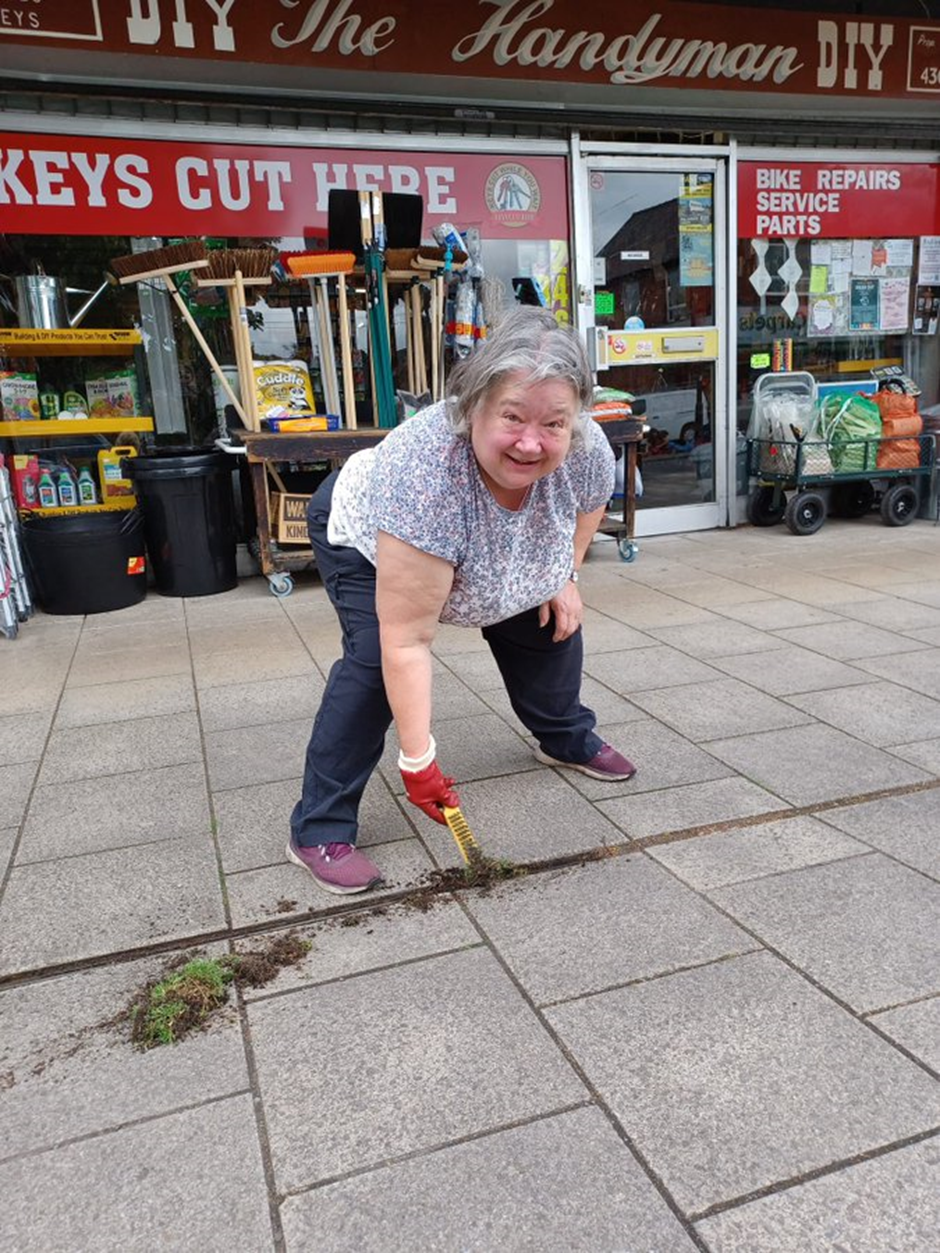


Councillor’s grass-clearing photo opportunity leaves more questions than answers.

Local Politicians Posted on Fri, November 20, 2026 07:29

20th November 2026

A photograph of a Liberal Democrat councillor holding a large clump of grass was supposed to demonstrate action in Romiley. Instead, questions remain about the work carried out, the effectiveness of the exercise and, most intriguingly, where the grass came from.

A little bit of grass has turned into a rather bigger question for local politics in Romiley.

In August 2025, Councillor Angela Clark was photographed apparently clearing a roadside gulley in Romiley village, proudly displaying a substantial sod of grass.

The photograph appeared to show a councillor getting stuck into a local maintenance problem.

But was this really a meaningful piece of work, or was the publicity considerably greater than the practical achievement?

The original report published by the Romiley Gazette on 10 August raised several questions which deserve proper answers.

According to the report, only approximately three to four feet of the gulley appeared to have been cleared.

That immediately raises the question of why such a short section was tackled and whether the work made any meaningful difference to the drainage or cleanliness of the area.

If a gulley needs attention, surely residents would expect the problem to be properly addressed rather than a small section being cleared for the camera.

The mystery of the missing grass

Perhaps the most intriguing aspect of the photograph was the large clump of grass being displayed by the councillor.

Residents familiar with the location reportedly questioned where it had come from, arguing that the gulley had never contained vegetation on anything like the scale suggested by the photograph.

A second photograph, taken immediately after the exercise, was also said to show little evidence of substantial vegetation in the surrounding area.

This does not establish where the grass originated, but it does raise a perfectly reasonable question.

Was it actually removed from the gulley, and if so, precisely where?

It should not be difficult to provide a straightforward explanation.

Was the job actually completed?

There is another issue which deserves attention.

Clearing a few feet of a gulley may make for a photograph, but residents are entitled to know whether the underlying maintenance problem was resolved.

Was the drainage improved? Was the entire affected section inspected? Was further work required? Did the council record the job as completed?

These are basic questions about the effectiveness of local maintenance, not unreasonable demands for information.

Councillors are elected to represent residents and scrutinise the services provided by the council. They should be able to explain what their interventions achieve.

Questions submitted to the area committee

The original Romiley Gazette report stated that a formal question had been submitted to the Werneth Area Committee, seeking answers about the limited extent of the clearance, its effectiveness and the origin of the grass.

The committee provides an important opportunity for local issues to be raised and councillors to be held publicly accountable.

However, the questions deserve clear answers rather than being allowed to disappear into the machinery of council business.

The issue is not whether a councillor should ever get involved in practical local work. Of course they should.

The issue is whether residents are being shown a genuine improvement or simply a photograph which creates an impression of activity.

Romiley deserves substance, not just photographs

Local residents do not expect their councillors to solve every problem personally.

They do, however, expect them to identify problems, press the relevant council departments for action and make sure that work is completed properly.

A photograph of someone holding a clump of grass is no substitute for evidence that a maintenance problem has been resolved.

If the work was effective, the councillor should have no difficulty explaining what was done and what improvement followed.

If it was only a small initial clearance, residents deserve to know what further action was planned.

And if the grass came from somewhere other than the gulley, that too should be clarified.

The questions are straightforward:

  • Exactly which section of the gulley was cleared?
  • Why was only three to four feet tackled?
  • Was the drainage problem actually resolved?
  • Was the grass in the photograph removed from that gulley?
  • Was any further maintenance commissioned or completed?

Councillor Clark and Stockport Council has already had an opportunity to answer these questions. No response was received.

In local politics, it is easy to take a photograph suggesting that something has been achieved. The real test is whether anything has actually improved for the people who live there.

Romiley residents deserve the answer – and perhaps a little less posing and a little more proof.